

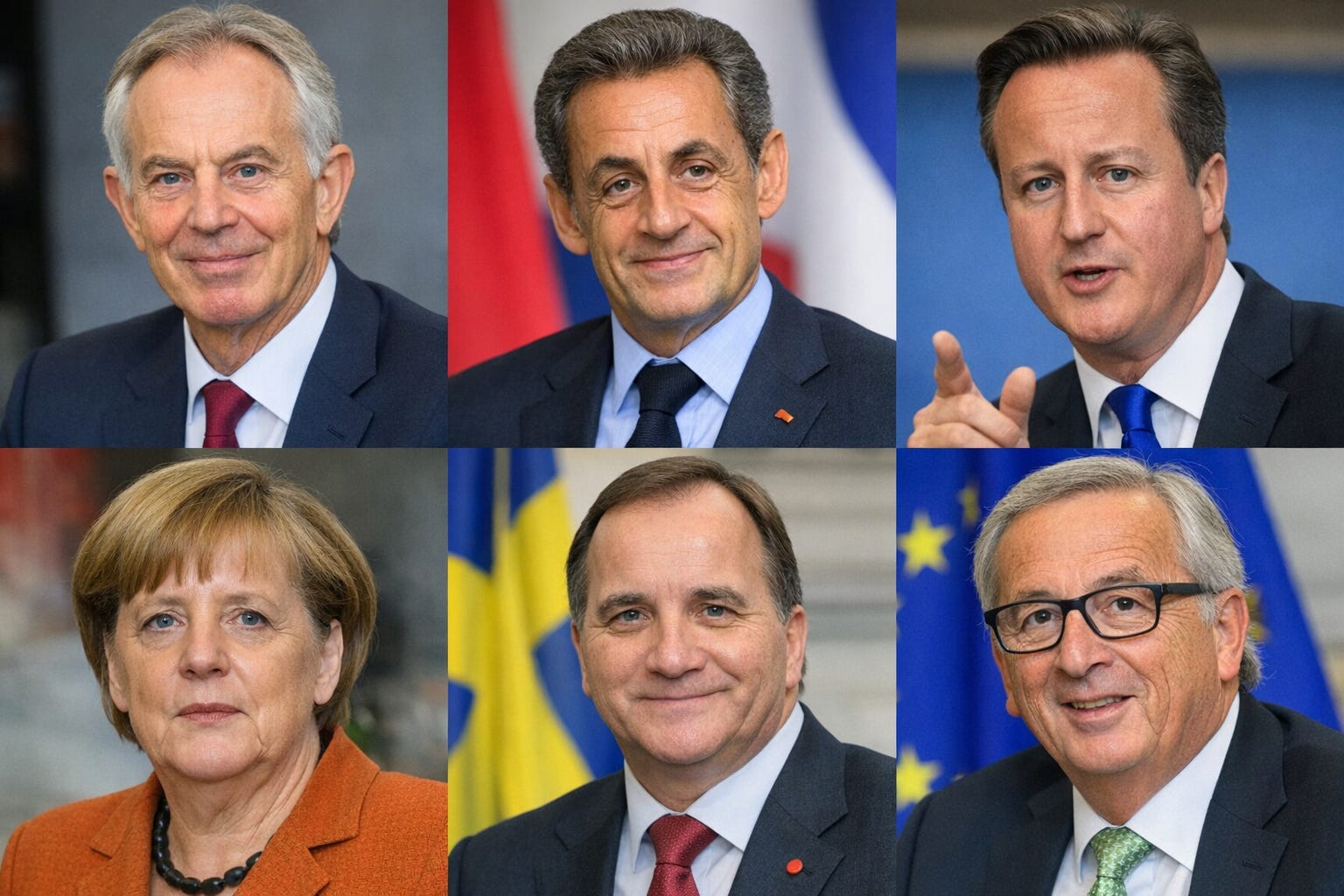
Tony Blair (United Kingdom, Prime Minister 1997–2007)
Blair’s Labour government pursued an open immigration policy to promote multiculturalism and economic growth, admitting record numbers of migrants, including from Muslim-majority countries like Pakistan and Bangladesh. Additionally, his support for the 2003 Iraq War contributed to regional instability, displacing millions and leading to refugee flows into Europe. Critics, including former aides, have admitted the policy encouraged mass migration without public consultation, altering the UK’s demographic landscape.
Nicolas Sarkozy (France, President 2007–2012)
Sarkozy co-led the 2011 NATO intervention in Libya alongside the UK and US, which toppled Muammar Gaddafi and plunged the country into chaos. This created a power vacuum that facilitated migrant smuggling routes across the Mediterranean, leading to increased flows from sub-Saharan Africa and the Middle East, many transiting through Libya. The intervention is often linked to the surge in irregular migration to Europe in the 2010s.
David Cameron (United Kingdom, Prime Minister 2010–2016)
Cameron authorized the UK’s involvement in the 2011 Libya intervention, which destabilized North Africa and opened migration corridors. His government also maintained relatively open policies for asylum seekers and workers from Muslim-majority countries amid EU free movement. The Libya fallout contributed to the 2015 migrant crisis, with thousands crossing into Europe via sea routes.
Angela Merkel (Germany, Chancellor 2005–2021)
Merkel’s 2015 decision to suspend the Dublin Regulation and declare “Wir schaffen das” (”We can do it”) allowed over a million refugees, primarily from Syria, Afghanistan, and Iraq—Muslim-majority countries—to enter Germany. This policy, responding to the Syrian civil war, influenced EU-wide migration dynamics and is credited with integrating many but also sparking political backlash across Europe.
Stefan Löfven (Sweden, Prime Minister 2014–2021)
Under Löfven, Sweden adopted one of Europe’s most generous asylum policies, accepting over 160,000 refugees in 2015 alone, many from Syria and other Muslim-majority nations. This per-capita high intake contributed to Sweden’s diverse Muslim population but later led to policy reversals amid integration challenges and rising far-right sentiment.
Jean-Claude Juncker (European Union, Commission President 2014–2019)
As head of the European Commission during the 2015 crisis, Juncker pushed for mandatory refugee quotas across EU states, aiming to distribute arrivals from Muslim-majority conflict zones like Syria. His proposals, though partially implemented, facilitated the relocation of tens of thousands and symbolized the EU’s role in managing mass inflows, influencing national policies.