

For most of its history, the United States has treated population growth as an unquestioned good. More people meant more workers, more consumers, more soldiers, and more national power. Yet in the twenty-first century, that assumption deserves re-examination. With automation reshaping labor, environmental limits becoming unavoidable, and quality of life increasingly strained, the question is no longer how many people America can hold, but how many it can support well.
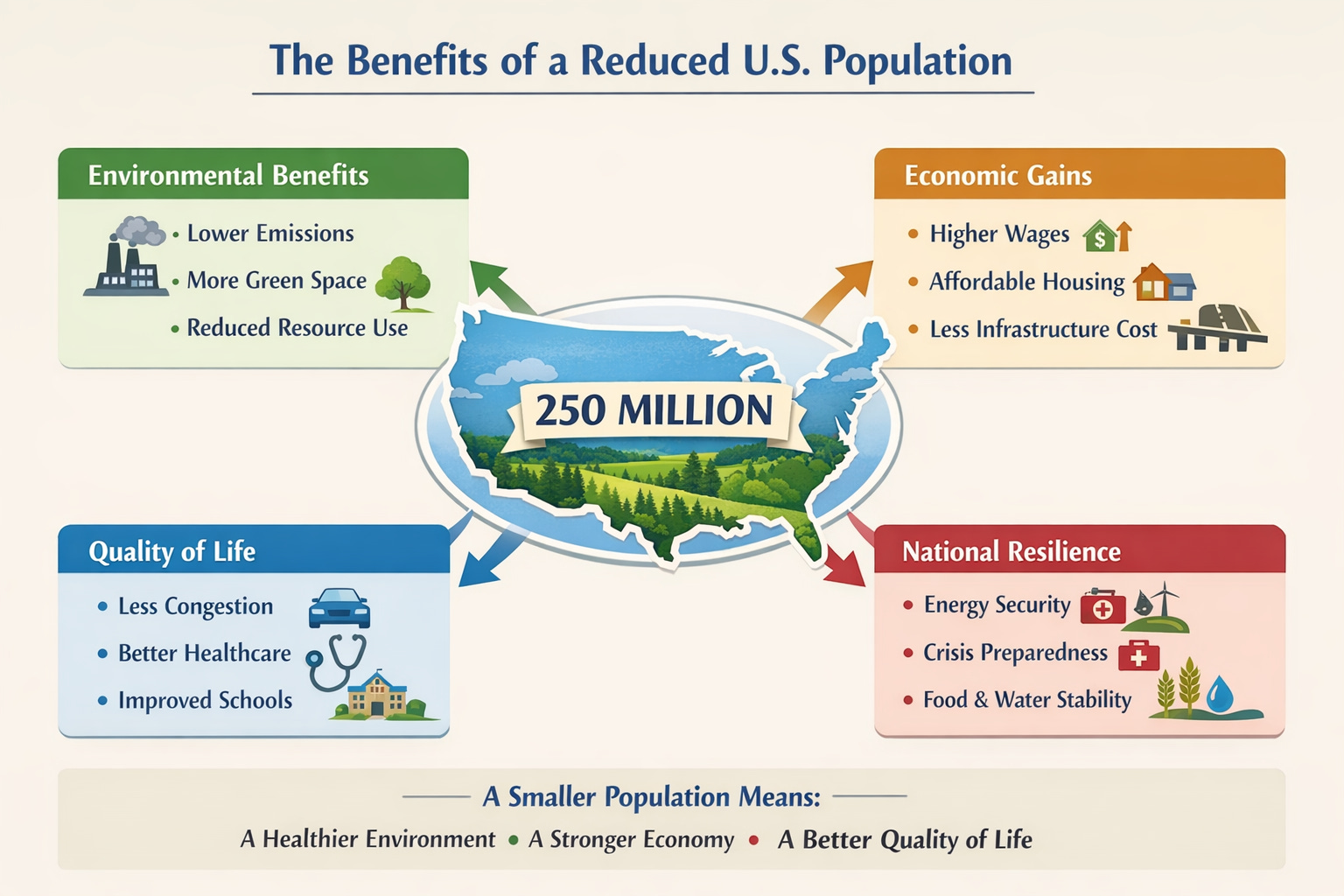
A gradual reduction of the U.S. population from roughly 335 million today to around 250 million over the course of several generations, achieved through voluntary demographic choices rather than coercion, would bring significant environmental, economic, and social benefits. Far from weakening the nation, a smaller population could make the United States more prosperous, resilient, and livable.
Environmental Sustainability and Ecological Recovery
The United States has one of the highest per-capita ecological footprints in the world. Americans consume more energy, water, land, and raw materials per person than nearly any other large population. While technological efficiency can reduce environmental damage, scale still matters. Even clean technologies require mining, land use, and infrastructure.
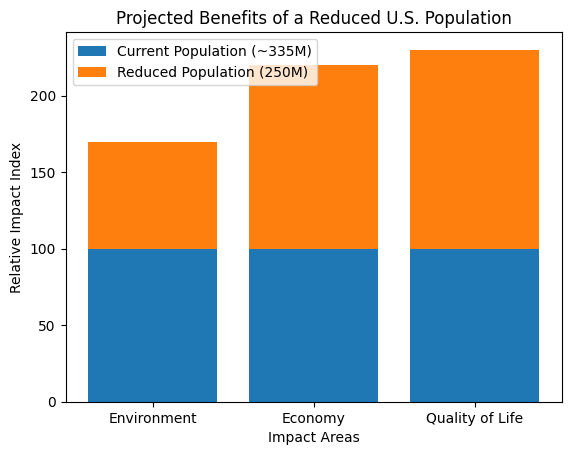
A population of 250 million would dramatically reduce cumulative environmental pressure. Fewer people mean lower total greenhouse gas emissions, even if per-capita emissions remain constant. It also means less sprawl, fewer highways carved through ecosystems, and reduced demand for intensive agriculture that degrades soil and water systems.
Land recovery would be one of the most profound benefits. As population density eases, marginal farmland could return to forests and grasslands, restoring carbon sinks and biodiversity. Water systems, especially in arid regions like the Southwest, would face less extraction stress. Aquifers could recharge. Rivers could flow more freely. Wild spaces would no longer be an afterthought squeezed between developments.
Environmental regulation also becomes more effective when demand pressures are lower. Conservation stops being a constant uphill battle and becomes a plausible long-term strategy. In short, a smaller population makes sustainability easier, cheaper, and more durable.
Economic Prosperity Without Endless Growth
Modern economies no longer require perpetual population growth to thrive. Productivity gains now come primarily from technology, automation, and human capital rather than raw labor numbers. In fact, excessive population growth can suppress wages by oversupplying labor, particularly in lower-skill sectors.
A reduced population would likely increase bargaining power for workers. Labor shortages in critical fields could push wages higher, improve benefits, and encourage investment in training and automation rather than reliance on cheap labor. This shift would reward skill, efficiency, and innovation rather than scale alone.
Infrastructure costs would also decline. Roads, bridges, utilities, and public services are enormously expensive to build and maintain, especially when cities sprawl outward to accommodate growing populations. With fewer people, existing infrastructure could be upgraded and maintained rather than endlessly expanded. Public spending could shift from quantity to quality.
Housing affordability would improve as well. Much of America’s housing crisis stems from demand outpacing supply in desirable areas. Lower population pressure reduces speculative land values and eases rent inflation, making home ownership more attainable and reducing homelessness.
Importantly, a smaller population does not mean a smaller economy in meaningful terms. GDP per capita, the measure that actually reflects individual prosperity, could rise. Wealth would be spread among fewer people, allowing higher average incomes, better public services, and more fiscal flexibility.
Quality of Life and Social Well-Being
Quality of life is where the benefits of a smaller population become most tangible. Less congestion means shorter commutes, cleaner air, and quieter neighborhoods. Public spaces become usable again rather than overcrowded. National parks and urban green areas regain their restorative function instead of becoming human bottlenecks.
Healthcare systems would face reduced strain. With fewer patients competing for limited medical professionals, wait times would shrink and care quality could improve. The same applies to education. Smaller class sizes consistently correlate with better student outcomes, higher teacher retention, and more individualized instruction.
Social cohesion may also benefit. Rapid population growth often outpaces a society’s ability to integrate newcomers, build trust, and maintain shared norms. A slower demographic tempo allows institutions to function properly and communities to adapt without constant pressure.
Mental health outcomes are closely tied to environmental stressors such as crowding, noise, financial insecurity, and long commutes. Reducing these stressors improves not just individual happiness but overall societal stability. A calmer society is a healthier one.
National Resilience and Strategic Stability
A smaller population enhances national resilience. During crises such as pandemics, natural disasters, or supply-chain disruptions, fewer people mean fewer vulnerabilities. Emergency systems stretch further. Food, energy, and medical supplies are easier to secure.
Energy independence becomes more achievable as total demand declines. The transition to renewable energy is easier when infrastructure does not have to chase ever-increasing consumption. Strategic reserves last longer. Environmental disasters become more manageable.
Contrary to fears, a population of 250 million would still leave the United States among the world’s most populous nations. Combined with advanced technology, high productivity, and global influence, demographic moderation would not diminish national power. It would sharpen it.
Achieving Population Reduction Ethically
Crucially, population reduction must be voluntary and gradual. No ethical argument supports coercion. History offers sobering lessons on that front. The path to a smaller population lies in education, economic security, access to family planning, and cultural acceptance of smaller families.
As societies become wealthier and more educated, fertility rates naturally decline. Supporting women’s education, reducing child-rearing costs, and removing incentives that favor population growth for its own sake all contribute to demographic stabilization. Immigration policy can also be calibrated to align with long-term sustainability goals rather than short-term labor demands.
This approach respects individual freedom while acknowledging collective responsibility.
Conclusion
The idea that a nation must endlessly grow to succeed is a relic of an industrial past. In an era defined by environmental limits and technological abundance, success looks different. It looks like clean air, affordable housing, meaningful work, resilient systems, and time to live rather than merely survive.
A United States of 250 million people would still be large, diverse, and powerful. But it would also be cleaner, wealthier per person, and more humane. By choosing balance over bloat, America could redefine prosperity not as endless expansion, but as a high quality of life shared sustainably across generations.
In the long run, smaller may prove not just beautiful, but wiser.